
Harford Court Records After Arrest
The court path after a Harford County jail arrest is separate from the jail lookup path. Booking records document the arrest intake at HCDC and the Interagency Processing Center. Court records document the filed charges, case number, hearings, bond decisions, warrants, and final outcome. Maryland Courts states that Case Search is the primary public way to search Maryland court case records, with summary information drawn from official case files.
Jail charges and court charges can differ. A person may be booked on one set of suspected offenses, then the State's Attorney may amend, dismiss, reduce, add, or decline charges as the court case develops. For custody and booking details, use Harford County jail inmate records. For booking photos, use Harford County jail mugshots. For filed criminal charges after arrest, use the Maryland courts route first.
Find Court Records After Arrest
Start with Maryland Judiciary Case Search for a public case-summary search. Narrow the search to Harford County when possible, and compare the name, court, filing date, case type, charges, and case number before relying on a result. If the arrest is very recent, the court case may not appear until the charging document is filed and processed.
The Circuit Court for Harford County clerk page is one official court source for records access when a case summary is not enough.
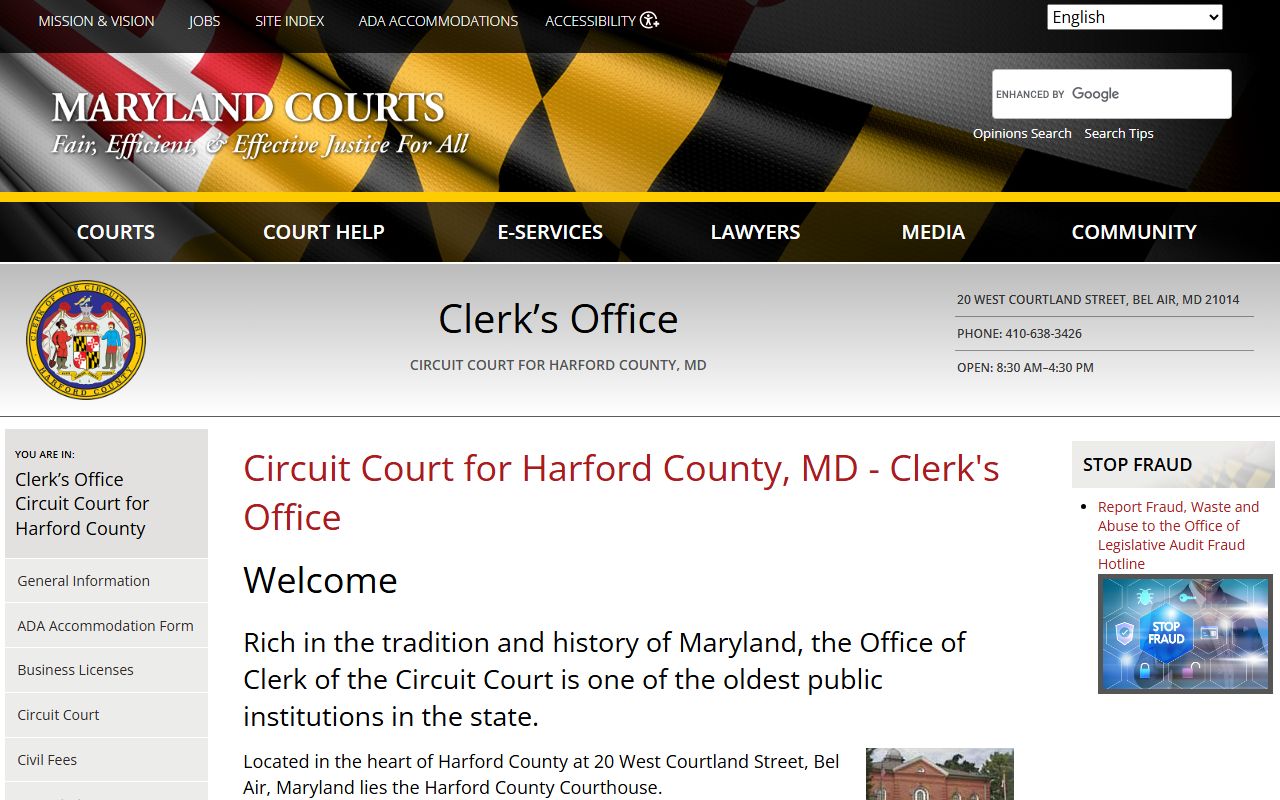
The clerk source is important because complete open case files are handled through court offices, not the jail.
- Confirm recent custody through VINE or HCDC if the arrest just occurred.
- Search Case Search by defendant name, or by case number if one is known.
- Narrow by Harford County, criminal or traffic case type, and filing-date range.
- Open likely matches and compare charge text, dates, court, and case number.
- Contact the District Court or Circuit Court clerk when Case Search is incomplete, restricted, or unclear.
The Maryland court-records hub explains that a full case file may be viewed in the clerk's office when the record is open to public inspection. Juvenile cases, sealed matters, expunged records, and some restricted filings may not be visible through the public search portal.
Harford Court Search Fields
Case Search works best when several fields are used together. A common name search can return cases from multiple counties or courts. The arrest date can help, but court filing dates may not match the exact jail booking date.
| Field Label | Type | Use | Notes |
|---|---|---|---|
| Search type | Tab or radio | Required | Person, company, or case-number style search. |
| Last name | Text | Primary | Use exact or partial legal name as the portal allows. |
| First name | Text | Optional | Narrows common names. |
| County | Dropdown | Optional | Select Harford to reduce statewide results. |
| Case type | Dropdown | Optional | Criminal, traffic, and other categories may appear. |
| Case number | Text | Required for number search | Use the number from a charging document, docket, or prior result. |
Charges After a Harford Arrest
The charging document is the bridge between an arrest and the court record. It may be a complaint, information, indictment, citation, or other Maryland charging paper depending on the offense and court path. The State's Attorney for Harford County prosecutes violations of state and local criminal statutes within its jurisdiction, while officers and courts may also create initial charging records.
| Document | Common Source | What It Does |
|---|---|---|
| Complaint | Officer or prosecutor | Starts many criminal cases with alleged facts and charges. |
| Information | Prosecutor | Filed by the State's Attorney to charge offenses without a grand-jury indictment. |
| Indictment | Grand jury | Charges serious matters after grand-jury action. |
The Office of the State's Attorney for Harford County is led by Alison M. Healey and lists felony, juvenile, misdemeanor, and victim/witness functions. Prosecutor-filed charges, court amendments, nolle prosequi entries, pleas, trials, and dispositions are court-record events, not jail roster events.
Harford Charge Status Meanings
Charge status changes as a case moves. A jail arrest may be followed by pending charges, amended counts, dismissed counts, nolle prosequi, stet, probation before judgment, guilty findings, not guilty findings, or other dispositions. A charge is an accusation. It is not a conviction unless the case ends that way.
| Status | Plain Meaning |
|---|---|
| Pending or active | The charge is open and the court has not reached a final disposition. |
| Amended or reduced | The filed charge changed from the original wording or severity. |
| Dismissed | The court dismissed the charge or count. |
| Nolle prosequi | The prosecutor chose not to proceed on that charge. |
| Probation before judgment | A Maryland outcome that is not the same as a standard conviction entry. |
| Guilty or not guilty | The charge ended by plea, trial, or court finding. |
Bond Records After Arrest
Bond and release decisions are court or commissioner functions. The jail does not set bond on its own. Maryland Courts defines a bail bond as a written obligation, with or without surety or collateral, conditioned on appearance as required. District Court commissioners are judicial officers and are available statewide 24 hours a day, 365 days a year.
| Bond Type | How It Works |
|---|---|
| Personal recognizance | Release based on a promise to comply and return to court. |
| Unsecured personal bond | A bond amount is owed if conditions are broken, but no upfront collateral is posted. |
| Cash bond | Cash is deposited to secure court appearance. |
| Surety bond | A licensed bondsperson or surety insurer posts the bond. |
| No-bond hold | The person remains in custody unless a judicial officer changes release status. |
The HCSO 2025 annual report lists 1,943 bail reviews. A hold from another court, probation or parole, federal authority, another agency, or ICE can prevent release even if one local charge has a bond amount.
Harford Court and Clerk Contacts
Use the court that has the case. The District Court of Maryland for Harford County handles many criminal, traffic, commissioner, and initial matters. The Circuit Court for Harford County clerk handles circuit criminal cases and full case-file access where records are open.
District Court of Maryland for Harford County
2 South Bond Street, Suite 100
Bel Air, MD 21014-3737
410-836-4545
8:30 AM-4:30 PM, Monday-Friday except legal holidays
Circuit Court for Harford County
20 West Courtland Street
Bel Air, MD 21014
410-638-3426
8:30 AM-4:30 PM
Warrants and Arrest Records
A warrant can create both jail and court records. HCSO has a Wanted section in its navigation and lists the Apprehension/Warrants Unit at 410-836-5457. Maryland Case Search may also show failure-to-appear events, warrant-related docket entries, or active case status when public. If safety, arrest risk, or a surrender question is involved, contact the court or an attorney instead of relying only on a web search.
- Bench warrant
- A warrant usually issued after failure to appear or comply with a court order.
- Detainer
- A hold or request from another agency that can keep a person in custody.
- Fugitive warrant
- A warrant from another jurisdiction that may lead to transfer or extradition.
Charges vs Convictions
Public case records can show accusations that never become convictions. A pending charge means the government has filed an allegation. A conviction requires a guilty plea, trial finding, or other qualifying outcome. Case Search users should read each count and disposition rather than treating an arrest result as a final record.
| Charge | Conviction | |
|---|---|---|
| Stage | Filed accusation after arrest or investigation. | Final result after plea, trial, or court finding. |
| Meaning | Not proof of guilt. | Formal finding or plea outcome. |
| Where found | Court docket and charging records. | Court disposition and sentencing entries. |
Sealed or Expunged Records
Some court records after arrest are not available in public search results. Juvenile records are generally not public. Sealed records, expunged matters, restricted filings, and some active investigatory materials may be withheld or hidden from public portals. Maryland Criminal Procedure § 10-105 governs expungement petitions for eligible police, court, and other state or local records after listed outcomes.
| Sealed | Expunged | |
|---|---|---|
| Public view | Hidden or restricted from public access. | Removed from public access under the expungement order. |
| Path | Usually by court rule or order. | By petition or statutory process when eligible. |
| Use | Limits public access to sensitive records. | Clears eligible police, court, or agency records from public view. |
Public Access Limits
Maryland public access law is source-specific. Court cases use Case Search and clerk inspection when open. Sheriff booking, police, CAD, photo, and video records use the HCSO PIA process. State prison case records have separate correctional-services limits. A single Harford County arrest can therefore require more than one office to reconstruct custody, charges, release terms, and final disposition.
Important: Do not use casual court or jail lookups for FCRA-covered screening decisions such as employment, housing, insurance, or credit.